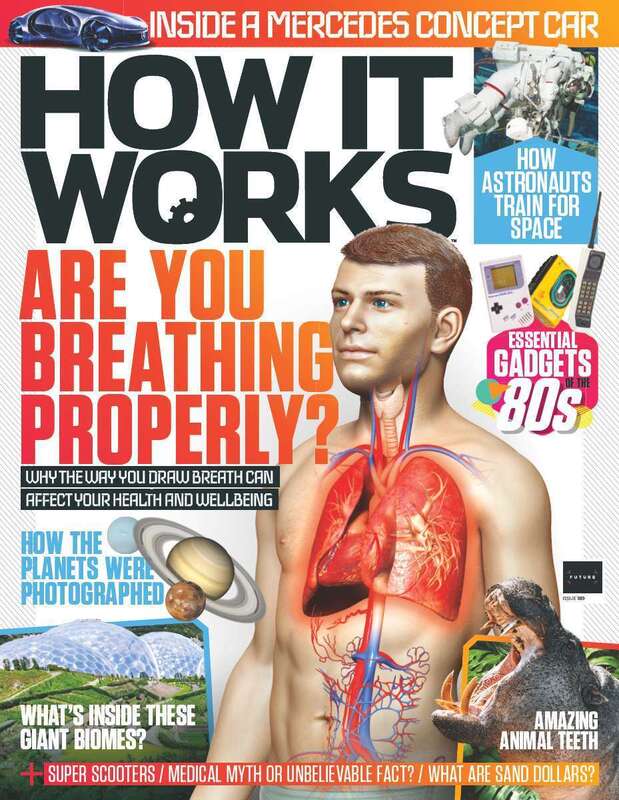

Issue 8 is another splendid feast for the mind, so read on to discover the highlights of this month's edition of your favourite science and technology magazine.
First up is this month's rather swanky cover feature: Mega Yachts. You won't believe the high technology and advanced design of these masters of the seas. In this four-page extravaganza we look at the biggest and best the yachting industry has to offer, and we even knocked up a little brainstorm of what our ...
The most commonly used component in streetlights is called a cadmium sulphide photoresistor, or a CdS cell for short. The CdS cell changes the resistance of a circuit depending on the amount of light shining on it. When lots of light falls on a CdS cell, then the resistance is very low, which means it conducts electricity well. When there is not much light, the photo-resistor has a high resistance which means not much current can flow.
This change in current can then be used to control ...
Check this video out from IBM detailing the process it has implemented to create a map of the world on a nano scale.
Amazingly, this fantastic new nano-manufacturing process allows for 1000 Earth's to be written onto a single grain of sand. The scientists accomplished this through a new, breakthrough technique that uses a tiny, silicon tip with a sharp apex — 100,000 times smaller than a sharpened pencil — to create patterns and structures as small ...
How It Works hits the shops today so don't delay – get yours now.
The latest edition of How It Works is not to be missed. We really don't know where to start as there's so much crammed in this month. As well as our exclusive interview with Professor Brian Cox, we also have hundreds of fine facts to feast on. Here are the highlights: inside the iPad, emergency vehicles, petrol pumps, hydrogen-powered cars, dolphins, quicksand, coral reefs, optical illusions, space-exploring robots, human muscles, smoke alarms, Neptune, Spitzer Space Telescope, dialysis ...
Switching on a fan and feeling a nice breeze can feel very refreshing on a hot day, but what is going on? Is the fan taking some of the heat energy away? In a small, perfectly insulated room, switching on a fan can increase the temperature in the room as fans usually have a motor which gives out heat.
The reason why fans make you feel cool is due to something called the wind-chill effect. Blowing air over your skin causes quicker evaporation of sweat which allows ...
So who's up for an early-bird preview of the latest issue of How It Works, which doesn't officially go on sale till 22 April? Issue 7 is crammed with more science-, technology-, history-, transport-, space- and environment-based wonder than ever before.
We thought we'd start off by taking a look at emergency service vehicles. In the event of a disaster, the emergency services are always on hand to sort things out. From cop cars with high-tech ...
The Apple iPad, following unprecendented sales in the first week of its American release, is to see its international release pushed back by a month to 10 May. The decision by Apple came after 500,000 units were sold in the first week, 300,000 on the first day of sales. In a press release issued by Apple, the company blamed the delay on the huge demand for the product in America, which it said had been "surprisingly strong" and that "demand is far higher than we predicted and ...
The official name for an aircraft speedometer is an Airspeed Indicator or ASI. Airspeed is a measurement of the plane’s speed relative to the air around it. On the aircraft there is a tube called the pitot tube. The open end of the pitot tube is usually mounted on a wing and faces toward the flow of air. The airspeed indicator actually measures the difference between a static sensor inside the plane (not in the air stream) and a sensor (the pitot) in the air stream.
When ...
There have been many different attempts by scientists and engineers to devise a way to build a space tether or ‘elevator’ and yes most of them involve constructing a really long cable of some kind – 38,000km or more to be exact!
The idea is that the cable would be in a geostationary orbit around Earth, one end of the cable would be attached to either a fixed or mobile platform on the Earth and the other end would connect with some kind of counterweight, high above the Earth’s atmosphere. ...
Europe's first mission dedicated to studying the Earth’s ice was launched today from Kazakhstan. The satellite's mission is to monitor how the Earth's ice levels are being affected by world wide global warming and send data back to the ESA (European Space Agency) for processing.
The original CryoSat, which attempted to enter low-Earth orbit in October 2005, unfortunately was lost during the launch as the second stage engine of the modified Russian SS-19 ICBM it was riding on did not cut-off as planned.
The CryoSat-2 satellite was launched at ...