

What are saturn’s rings made of?
They may not be as interesting as the moons around Uranus but Saturn’s rings do bear further investigation…
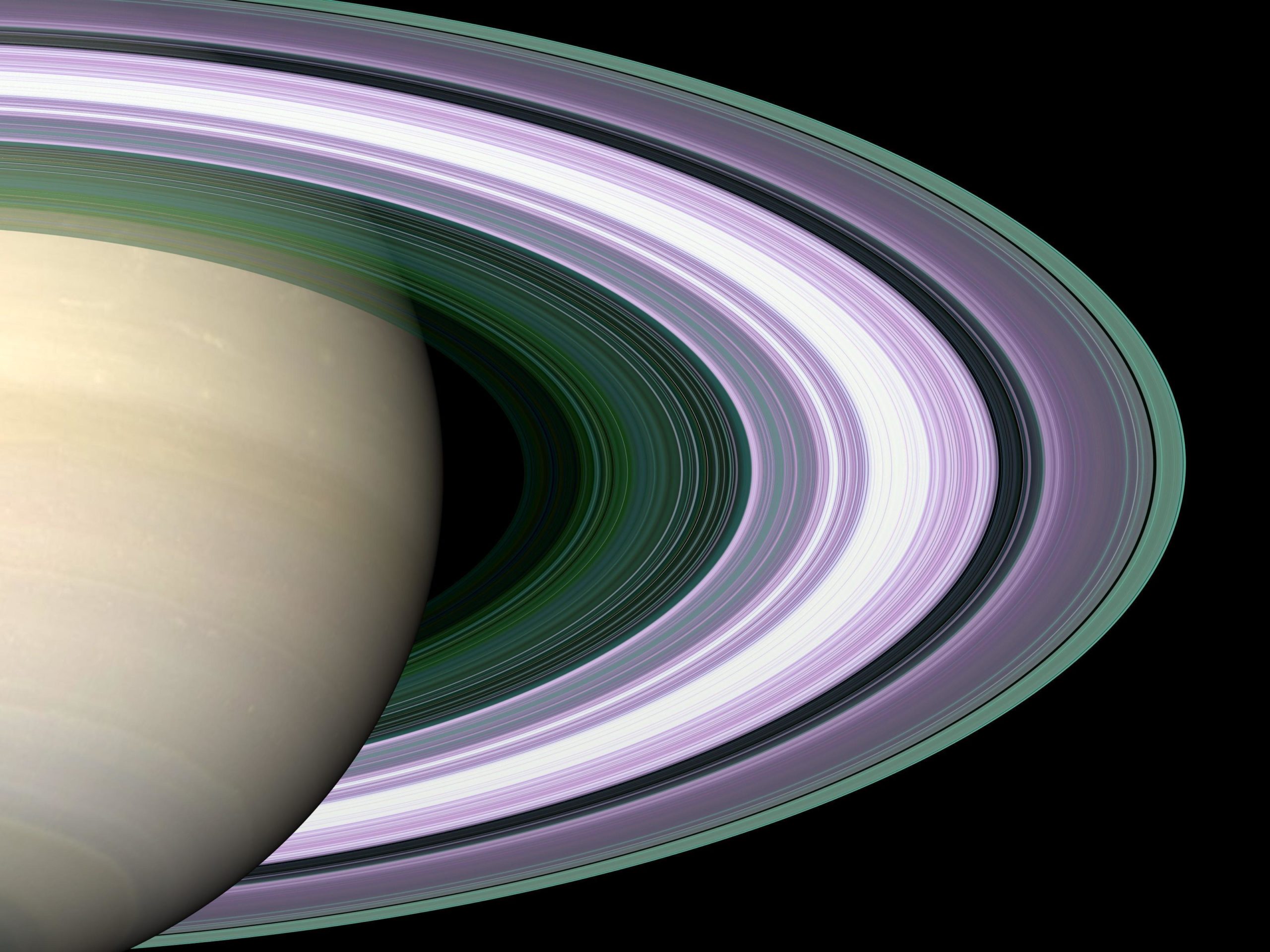
Image credit: NASA/JPL
Saturn – The Roche lobe causes gravitational forces around Saturn to hold rocky particles
Inner rings – Inner rings are made up of rock particles that never formed into a moon
Outer rings – Outer rings are caused by geysers in the south pole of Saturn
Why does Saturn have rings? The answer has to do with something called the Roche lobe, named after a French astronomer. It seems when a planet orbits around a star (eg our Sun) and that planet has its own orbiting objects (eg a moon), a gravitational pull occurs between the objects. Around Earth, orbiting rocks formed into the moon. On Saturn, the rocks never coalesced and are still orbiting.
Interestingly, the rings are only a few miles in thickness because of the highly localised effects from the Roche lobe. Dr Steve Maran, a noted astronomer, says Galileo was the first to discover the rings, but could not explain them. Today, viewing angles from the Hubble Space Telescope reveal an enormous region extending widely around the planet. There’s also one distinct outer ring, which Maran attributes to geysers emitting from the icy southern polar region on Saturn, leaving a more distinct trail.
For more science and technology articles, pick up the latest copy of How It Works from all good retailers or from our website now. If you have a tablet or smartphone, you can also download the digital version onto your iOS or Android device. To make sure you never miss an issue of How It Works magazine, subscribe today!