The guillotine was the official method of execution in France until 1981
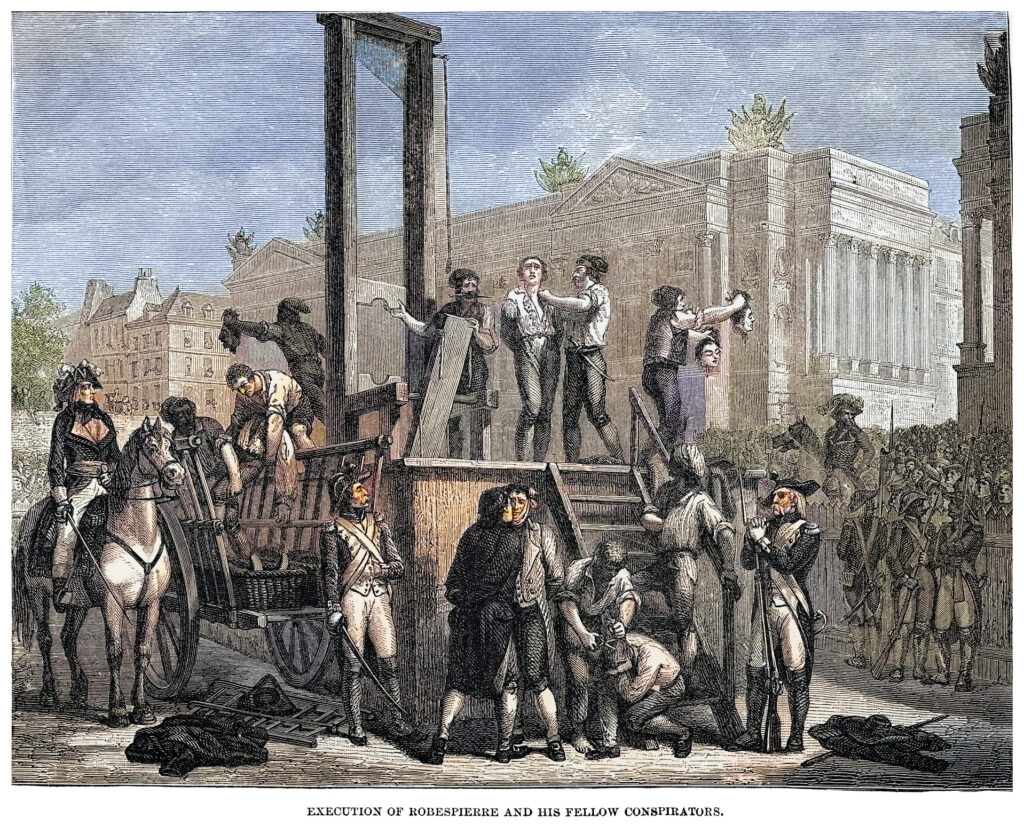
An illustration of French statesmen Maximilien de Robespierre and his fellow conspirators being executed via guillotine in 1794 (Credit: Getty Images/mikroman6)
For almost two centuries, the guillotine was used in France as an execution device in capital crimes – crimes that required punishment with the most severe of sentences. It was first used in the 1700s, during the French revolution, when executions were commonly held as public events. As an alternative to the brutal killing methods of the time – which included the guilty party being attached to animals and pulled apart – the guillotine was invented by a French surgeon and physiologist, Antoine Louis, with the aim of executing the sentence quickly with as little pain and suffering as possible.
The vertical wooden structure held a sharp blade, attached to a rope between two tall posts. Below the blade, the person being executed would be placed face-down with their head secured to prevent movement. As it fell onto the neck, the blade was designed to make a single, clean cut. During the French Revolution, the guillotine was used to execute thousands of people, including King Louis XVI. Executioners continued to use the guillotine until September 1981, when capital punishment was abolished in France.
Who was Dr Guillotin?
The guillotine wasn’t named after someone who wanted murderers to pay the ultimate price. In fact, Doctor Joseph-Ignace Guillotin opposed the death penalty. Guillotin was born in Saintes, France, in 1738, and from 1789 he became a Paris deputy to the French National Assembly. This meant he held some power in lawmaking. In his first year as part of the assembly, Guillotin helped pass a law stating that all executions be made by means of machine.
While the death penalty remained in force, Guillotin refocused his goal to make execution as pain-free as possible. The machine he suggested was a quick and simple alternative to burning people alive or hanging. Although he didn’t invent the device itself, because Guillotin advocated for these changes the machine was named after him.
For more science and technology articles, pick up the latest copy of How It Works from all good retailers or from our website now. If you have a tablet or smartphone, you can also download the digital version onto your iOS or visit Apple News+. To make sure you never miss an issue of How It Works magazine, subscribe today